
Green coffee defects are the flawed beans and foreign matter that end up in a sack of coffee: black beans, sour beans, insect-damaged beans, broken pieces, bits of husk, even stones. They matter for two reasons. They decide what grade a coffee earns, and the worst of them can spoil the flavor of a whole roast. A handful of black or sour beans can be enough to make a cup taste dirty, fermented or harsh.
This guide explains the main green coffee defects, what causes each one, how they affect the cup, and how they’re counted under both the Indonesian grading system and the Specialty Coffee Association (SCA) method. If you buy Sumatran coffee, it will help you read a grade, check a sample and talk to your supplier with confidence.
Green coffee defects at a glance
| What they are | Flawed beans and foreign matter in green coffee |
| Worst defects | Full black, full sour, fungus-damaged beans and foreign matter |
| Indonesian method | Defect points in a 300 g sample (SNI 01-2907-2008) |
| Indonesian Grade 1 limit | No more than 11 defect points per 300 g |
| SCA method | Category 1 and Category 2 defects in a 350 g sample |
| SCA specialty grade | No Category 1 defects and no more than 5 full defects per 350 g |
| Main causes | Picking, processing, drying, hulling, storage and pests |
| How they’re removed | Screens, density tables, optical sorters and hand picking |
What are green coffee defects?
A green coffee bean is the dried seed of the coffee cherry (Wikipedia’s article on the coffee bean covers its structure). Between the tree and the sack, a lot can go wrong, and green coffee defects are the result. Cherries can be picked unripe, over-fermented in processing, dried badly, damaged by insects, crushed in hulling or stored too long. Each of these leaves its mark on the bean.
Green coffee defects are usually split into two groups:
- Primary defects are the serious ones. Even a few can make a cup taste bad. Black beans, sour beans and fungus damage are in this group, along with stones, sticks and other foreign matter.
- Secondary defects are less severe on their own, but they add up. Broken beans, immature beans, shells and slight insect damage fall here.
Common green coffee defects and their causes
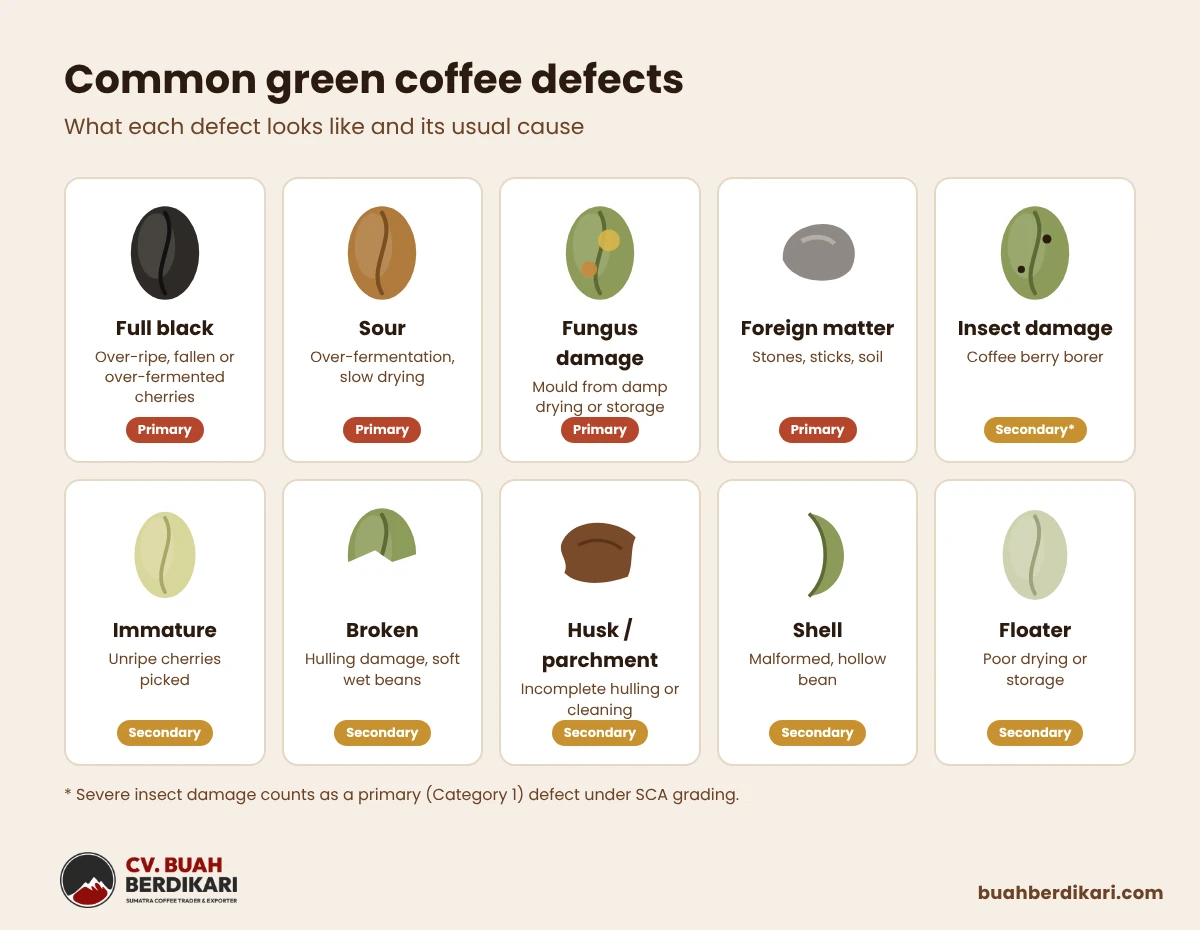
| Defect | What it looks like | Usual cause | Effect in the cup |
|---|---|---|---|
| Black bean | Partly or fully black, often shrunken | Cherries left on the ground, over-ripe or over-fermented; immature cherries | Dirty, flat, ashy, phenolic |
| Sour bean | Yellowish-brown to reddish-brown | Over-fermentation or delays in processing and drying | Sour, vinegary, fermented, rotten fruit |
| Fungus damage | Yellow or reddish spots, powdery patches | Mould from poor drying or damp storage | Musty, earthy, mouldy |
| Insect damage | Small round holes or channels | Coffee berry borer and other pests | Dirty, sour or rio-like if severe |
| Immature bean | Pale, greenish-yellow, wrinkled, silverskin stuck on | Unripe cherries picked | Grassy, astringent, peanutty |
| Broken, chipped or cut bean | Bean pieces or damaged edges | Hulling or sorting machines, especially on soft, wet beans | Uneven roasting and scorching |
| Husk or parchment | Bits of dried cherry skin or papery shell | Incomplete hulling or cleaning | Earthy, dirty; may burn in the roaster |
| Shell | Hollow, ear-shaped bean | Genetic deformity | Burns easily, uneven roast |
| Floater | Light, pale, low density | Poor drying or storage | Faded, papery, stale |
| Withered bean | Small, wrinkled, light | Drought or poor development on the tree | Grassy, thin |
| Foreign matter | Stones, sticks, soil, metal | Drying on the ground, poor cleaning | No flavor effect, but can damage grinders and roasters |
Research backs up why sorting matters. A study by Mazzafera (1999) in Food Chemistry compared black-immature, immature and sound beans. The defective beans had less sucrose, less oil and different levels of phenolic compounds, and mixing them into good coffee significantly changed the composition of the blend. In other words, defects don’t just look bad. They change what goes into the cup.
How green coffee defects are counted in Indonesia
Indonesian export coffee is graded under SNI 01-2907-2008, the national standard for green coffee. A 300 g sample is sorted by hand, and each defect is given points depending on how serious it is. The total decides the grade. Here are the most common defects and their points:
| Defect | Points |
|---|---|
| 1 black bean | 1 |
| 1 partly black bean | 1/2 |
| 1 broken black bean | 1/2 |
| 1 whole dried cherry | 1 |
| 1 brown (sour) bean | 1/4 |
| 1 large piece of husk | 1 |
| 1 bean still in parchment | 1/2 |
| 1 broken bean | 1/5 |
| 1 immature bean | 1/5 |
| 1 bean with one insect hole | 1/10 |
| 1 bean with more than one hole | 1/5 |
| 1 spotted bean | 1/10 |
| Large stone, twig or clump of soil | 5 |
The point totals translate into grades:
| Grade | Defect points per 300 g |
|---|---|
| Grade 1 | Up to 11 |
| Grade 2 | 12–25 |
| Grade 3 | 26–44 |
| Grade 4a | 45–60 |
| Grade 4b | 61–80 |
| Grade 5 | 81–150 |
| Grade 6 | 151–225 |
On top of the official grade, exporters often label Grade 1 coffee as TP (triple picked) or DP (double picked), which tells you how many times it was hand-sorted. Our full guide to Indonesian coffee grades explains every grade and label.
How the SCA counts defects
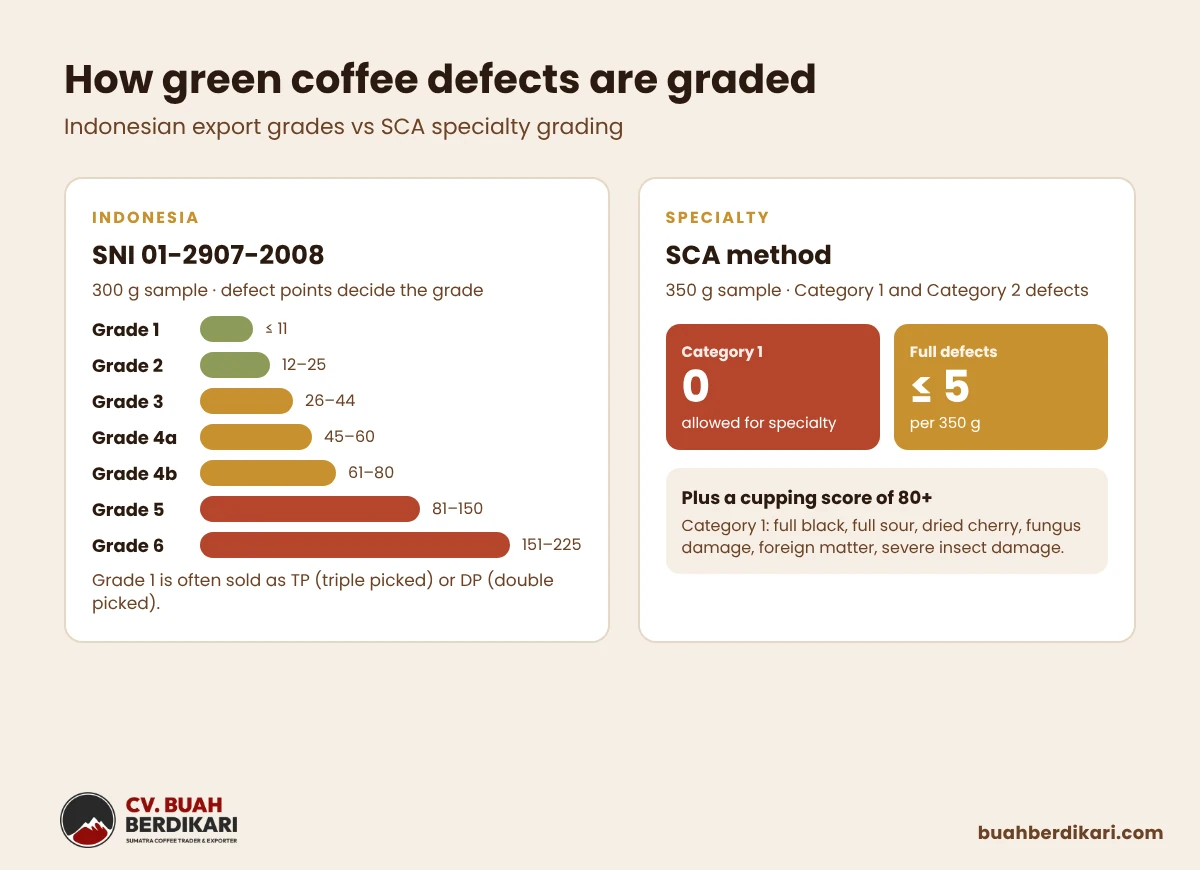
Specialty buyers often grade with the SCA method instead. It uses a 350 g sample and splits defects into two categories:
| Category 1 (primary) | Category 2 (secondary) |
|---|---|
| Full black | Partial black |
| Full sour | Partial sour |
| Dried cherry or pod | Parchment |
| Fungus damage | Floater |
| Severe insect damage | Immature or unripe |
| Foreign matter | Withered, shell, broken, chipped or cut, husk, slight insect damage |
Some defects only count once you have several of them. For example, a single full black bean is one full defect, while partial black beans are counted in threes. To make specialty grade, a sample needs no Category 1 defects and no more than five full defects in 350 g, and it must also score 80 points or more when cupped.
Green coffee defects in wet hulled Sumatran coffee
Most Sumatran Arabica is wet hulled: the parchment comes off while the bean is still soft and damp. That process gives Sumatra its heavy body, but it also makes some defects more likely.
- Broken and damaged beans. Soft, wet beans crack and deform more easily in the hulling machine.
- Uneven drying. Naked beans dry quickly on the surface. If drying is rushed or interrupted by rain, mould and sour beans can follow. Our post on coffee drying explains why this step matters so much.
- Foreign matter. Coffee dried on tarps or patios needs careful cleaning to remove stones and grit.
This is why the number of hand-sorting passes matters so much for Sumatran coffee, and why triple-picked lots carry a premium. Our guide to coffee processing explains wet hulling alongside the other methods.
How defects are removed
Green coffee defects are removed in stages after hulling:
- Screens separate beans by size and remove small pieces.
- Density tables separate light beans, such as floaters and immature beans, from dense, healthy ones.
- Optical sorters reject beans by color, catching most black and sour beans.
- Hand picking removes what the machines miss. Each extra pass lowers the defect count.
How to check green coffee defects in a sample
When a sample arrives, a quick count of green coffee defects tells you whether the lot matches its grade:
- Weigh out 300 g (Indonesian grading) or 350 g (SCA grading).
- Spread the beans on a black tray in good daylight.
- Pull out every defect and sort them by type.
- Add up the points or full defects, and compare with the contract grade.
- Roast and cup the sample to confirm there are no hidden taste defects.
Our guides to green beans coffee sampling and coffee cupping explain the full process. Remember that good storage keeps defects from developing after the sale. Our guide to green coffee storage covers how to protect your beans once they arrive.
Check our grades on your own table
Request green samples of our Gayo, Mandheling, Lintong and Sumatra Robusta and count the defects yourself.
You can see all our origins and grades on our Coffee Offerings page.
Frequently asked questions
What are green coffee defects?
Green coffee defects are flawed beans and foreign matter in green coffee, such as black, sour, insect-damaged or broken beans, husks, stones and sticks. They lower the grade and can spoil the flavor.
What is the worst coffee defect?
Full black and full sour beans, along with fungus-damaged beans, are the most serious. Even a few can give the cup dirty, fermented or musty flavors.
How many defects are allowed in Grade 1 coffee?
Under the Indonesian standard SNI 01-2907-2008, Grade 1 allows no more than 11 defect points per 300 g sample.
How many defects are allowed in specialty coffee?
Under the SCA method, specialty grade allows no Category 1 defects and no more than five full defects per 350 g, plus a cupping score of at least 80.
What causes black beans in coffee?
Black beans usually come from cherries that fell to the ground, over-ripened, over-fermented or never matured properly.
Can roasting fix green coffee defects?
No. Roasting can hide some flavors at darker levels, but it can’t remove defects. The only fix is sorting before you roast.
CV. Buah Berdikari is a coffee trading and exporting company based in North Sumatra, Indonesia. We source Arabica and Robusta green coffee from North Sumatra and Aceh and help roasters and importers find the lots that fit what they’re making.